How Much ‘Summer’ in Summer?

August is upon us and the back-to-school ads have started to appear.  Gardens are about to produce tomatoes and cucumbers galore.  Leaves on trees are looking a bit tired and worn here and there after shining in their green spectrum from early pale to later deep green.  We still have a couple more months to go before the plants all go dormant for the cooler months.


I haven’t taken a vacation, or even devoted a whole day to summer activities, but I have vicariously enjoyed those of friends and family on Facebook and in-person telling.  And I have thought about what constitutes a summer moment so that I don’t miss them when they occur.  In early June, I wrote this piece about summer and the importance of noting this season.


Summer isn’t just a season, it is an idea – a representation of things to strive for like relaxation and laughter with friends and family.  It is nostalgia in a different form than what the holiday season brings forth.  The sound of children laughing in early evening brings me back to those moments in long ago yards playing tag or chasing fireflies with a group of other kids.  The joy of still being up and out in the dark when we would normally have been tucked into bed.


Enjoying the idea of summer in adulthood takes effort, a deliberateness that wasn’t necessary in childhood.  First we have to be conscious that this effort is even required.  Summer was spontaneous in our younger years and we might expect this to continue, we might feel discontent when it does not.


For several years in the transition from child to adult, I didn’t think about summer much at all.  Perhaps because I was busy figuring out what being an adult meant for me.  Perhaps because I was doing this figuring out in California, where the seasons are subtle and mostly all have the feel of summer.  It wasn’t until my children were old enough to have a summer break in school, and summers had the same rhythm they had in my childhood that I started to think about what makes summer.


Then I was divorced with two boys and a full time job and I had to make sure they had a summer while basically foregoing one for myself.  Or so I thought because I thought of summer as long stretches of unscheduled time to explore and enjoy.

DSC03845

Now summer comes in moments, sips, or bursts.  And I enjoy them.

  • Time on a patio with family or friends
  • The hummingbird that visits the Rose of Sharon in the corner of my yard
  • Watching the tomato plants grow and tomatoes form
  • The firefly that hovered in front of the dog and I on a late evening walk
  • The dragonfly that reluctantly posed for this picture
  • The little boy gleefully whizzing by on his bike
  • The sound of lawn mowers while I still laze in bed on a weekend
  • Thunderstorms clearing the humidity from the air


How much summer is in your summer so far?


© 2014 BAReed Writing | Practical Business, All rights reserved

Waiting Patiently, Part 1

We decided to try our hands at a bit of vegetable and herb gardening again this year after a several year hiatus.  We just got a few things and put them in pots because I still haven’t settled on a ‘landscape design’ for the back yard.  (There is the one in my dreams that includes a 3 season room/conservatory, a patio, a beautiful new fence and award winning plantings…)  The last time I tried to raise a tomato plant I put it on the west side of the house and it got burnt and spindly and we managed to reap a single tomato from the poor thing before it became compost.


I think that I’ve learned a bit since then.  We’ll see if I have learned enough.  Now our tomato plants live on the south side of the house and are currently full of promise – about 18 tomatoes are developing between the two plants.  We also have peppers, mint and oregano.  We had basil, but a random wind burst blew a chair onto it and now it is in the process of dying.


We are already realizing that the herb books we possess have gaps – like when and how to harvest.  Perhaps the writer assumes we know this part…  In which case he or she is wrong.


I am enamored of the idea of gardening – decorative and produce.  I have a stack of gardening books that I look at and reference periodically, some practical and some fanciful.  Reading about our founding father’s deep interest in gardening, as gentlemen gardeners I realized that is around my level.  I want to talk about it, think about it, enjoy it and just occasionally do the heavy parts.  Plant something here, pull a weed there, rely upon thick layers of mulch to prevent weeds and help retain moisture.  Unfortunately I don’t have the financial resources to pull off this sort of gardening.


Watering is a Zen activity that falls happily in my version of gardening.  Some days the plants have to wait patiently while I participate in other activities and interests, though.

DSC03847

Gardening is perfectly suited to the acquisition of knowledge – it is forgiving of novice mistakes if you start slowly and allow for changes in plans.  Gardening is helping me to practice the patience that I have mostly lacked in other parts and earlier stages of my life.


You’ll have to excuse me now, I feel the need to go take a tour through the yard.


© 2014 BAReed Writing | Practical Business, All rights reserved

There Will Be Exasperation

I’ve just sat down and gotten comfortable, so of course the dog now wants to go out.  This is exasperating.


Picking up one too many things to put back in their proper place, so everything slides and clangs and rolls away on the floor.  This is exasperating.


Dropping one of my earrings as I walk out of my room and put them on at the same time because I am already pressed for time.  This is exasperating.

DSC03760

Going just a little too long between meals, trying to do that one more thing when tired, being unable to stretch just that tiny touch more to grab something needed when constrained – these are exasperating.


Being unable to retrieve the word that I want, or remember the association that would fit well into a conversation, or find that mosquito that buzzes in my ear when the lights are off and I am just about asleep.  Exasperating.


Having someone bring in dirty dishes just as I finish up in the kitchen.  Grrr.  Having the phone ring a couple of minutes before the end of the work day.  REALLY??


Vexing, infuriating, aggravating, inflammatory things happen every day, plenty of times per day to rankle each and every one of us.


Thankfully there is also laughter and beauty and kindness.  The dog wags her tail and smiles at me when I grumblingly go over to let her out and shortly thereafter let her back in.


I don’t have any interest in spending my hours feeling indignant much of the time.  I can remind myself to eat in a timely manner to stave off those blood sugar dips that result in a foul mood.


It’s a mind game that I can play better some days than others.  How about you?


© 2014 BAReed Writing | Practical Business, All rights reserved

Galloping or Inching

Progress is progress I tell myself on a regular basis – whether by inches or gallops.  I need this reminder because inches don’t feel like progress, especially when new things get added on faster than stuff gets done.  (Clearly this is on my mind, I return to some version of this theme quite a lot lately.)  Did I push it forward, or can I change the priority, or can I get some help?


Most people I know, particularly women, focus on all the things yet to do which makes it harder to feel like progress has been accomplished at all.  There is always more to get done, it doesn’t matter what you are talking about – personal, professional, family household, etc.  Relentless obligations.  Job security.  Life in our modern, complex world.


We want to gallop through our endless lists, but mostly we inch.


Inches matter and they do add up, but sometimes we have to remember where we started at to see how far we have come.  Reminding myself of the steps that I have taken that day to affect progress is a habit that I work to keep up.  Done, started, planned, researched, delegated, reprioritized.  Don’t spend all the time looking at what hasn’t yet been done.  Breathe, and then review what was accomplished at the end of each day – work and personal.


public domain image

public domain image

I admit to being better at sharing this nugget with others than I can be at following it for myself.  Although this is one of the ways that I put myself on the path to being a reformed perfectionist years ago.  (It is a path with no finish.)


A coworker came across a free webinar offering about remarkable women in leadership roles and sent out an invitation for anyone interested to join her in her office for this presentation.  A handful of us expressed interest and so spent an hour together listening and actively thinking about where we are and where we could be.  This aspect of accomplishment came up in relationship to confidence.


If a women is apt to focus on this things yet to do then she is less likely to feel confident in her abilities.  A rearranged focus that acknowledges the things completed or well on their way is a step toward confidence.  Doubt loses some of its foot-hold.


I wanted to ask my coworkers a bit about this and some of the other points from the presentation, but since we had spent an hour listening everyone felt pressed to get back to their lists of to-dos.  The march to inch forward.


© 2014 BAReed Writing | Practical Business, All rights reserved

How Many Things Can Your Mind Juggle?

Back in my early adulthood, I thought I was overwhelmed when I had a couple of issues at the same time; say one personal and one work issue.  Mind boggled.  But I slowly adjusted and found that I could handle a couple of different issues at the same time and maintain regular stuff as well.


Then I had kids and had to mentally juggle my stuff, house stuff and their stuff.  Sometimes I missed a few balls, but I did pretty well because there became an ebb and flow to activity that followed the school year.  My mind could rest a bit here and there.


I’ve had periods, sometimes years, when I had to adjust to constant mental juggling, without the relief of that ebb in activity.  Mostly I think I met the challenge.  Often by letting less important things fall to the wayside for a bit.


I was told once, by someone who should know, that our minds are suited to holding 7-9 thoughts or ideas in short term memory.  Any more and something has to go to long term memory or get dropped off the mental cliff.


public domain clip art

public domain clip art

So this idea of time management (and information management) is more than being in the right place at the right time with the right tools, it is conquering your short term and long term memory capabilities – because I know plenty of people, particularly women, who are trying to shove 25 items into their short term memory and feeling frazzled as a result.


I just rewrote my current to-do list of reasonably important tasks, appointments and such.  (Yes, still using pen and paper because that act helps me to keep everything clear.)  I am scheduling a roof replacement that has been on my list for about 3 years.  (The contractor said he has seen worse roofs, but I don’t want to get backed into that corner so getting this off my list will be a relief.  The next heavy rain won’t make me cringe.)


A few things were completed and didn’t have to be carried over onto the new list.  And a couple of things came up in the intervening time and had to be done without even making it onto the official list.  I remembered a few things that should have been on the last list, but got lost in the nether regions of my mind.  Plus a few new things.  So the list is longer and looks like I haven’t gotten anything done.  (Sigh.)


How many things can you mind juggle?  And do you live with the constant sense that you are forgetting something?


© 2014 BAReed Writing | Practical Business, All rights reserved
Generosity Toward a Parent

I have had a variety of conversations in recent weeks that when strung together in my thoughts seemed to have similar elements.  The conversations weren’t about the parent-child relationship, but the theme took shape.  It is a central relationship, one that plenty of people experience from each side.


As I became a parent, I started to look at my relationship with my own parents differently.  I hadn’t evaluated it since it was a child to adult dynamic.  But I realized that my mom particularly had changed the way that she approached our relationship so that it was adult to adult.  That shift doesn’t always happen when the child moves into adulthood – one or the other side, or both, may prevent it or resist it.


I used to have conversations with my mom about the parent-child relationship dynamic – in relation to ours and to mine with my boys.  The conversation tended to come up as the boys transitioned to a new stage of development.  I have really missed the conversations these past years as the boys moved through their later teens and now as I work on forging my side of the adult to adult version with each of them.


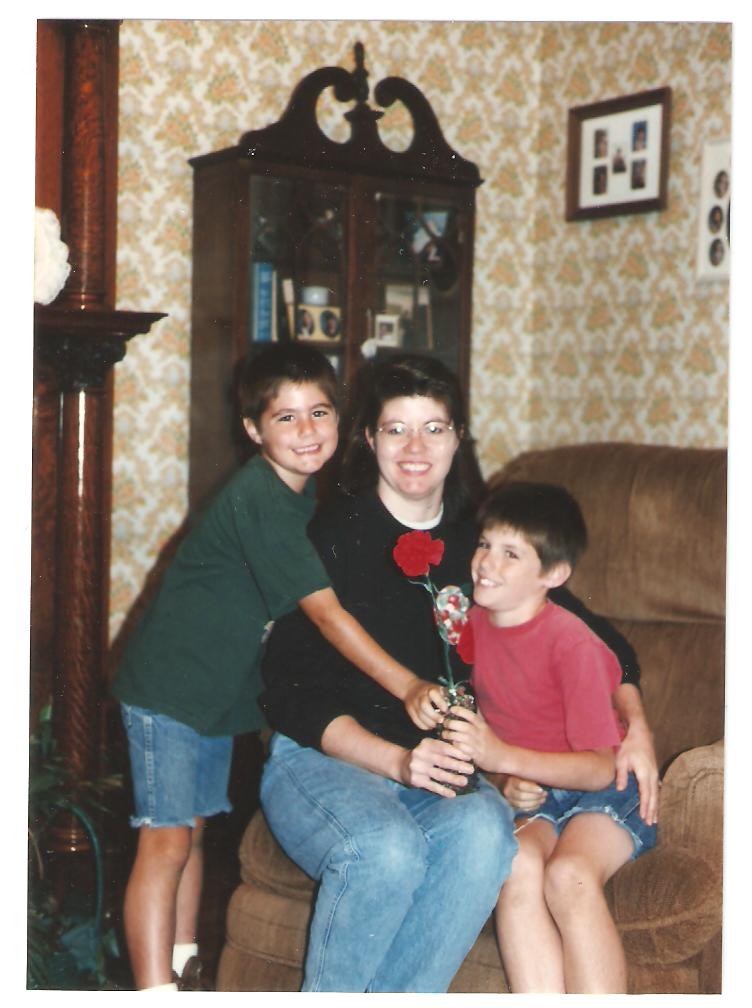
The shift really starts to come along at the point that the child sees the parent as a person separate from their parental role, it seems to me.  There are glimpses throughout childhood.  I am reminded of a period when the boys took to walking over to a flower shop that a neighbor ran and each buying me a single cut flower.  I think that they initially got the idea from a neighborhood girl, but then kept it up because I showed such delight in their generosity.  They were in early grade school so maybe about 6 or 8.


the first flower

the first flower

I’ve mentioned before that my mom went to college starting when I was in grade school.  This meant that she was enmeshed in her own homework and learning experiences.  She graduated from college the same year my brother graduated from high school.  She became an instructor at the same college that I went to and I had to learn to call out her name and not ‘Mom’ if I saw her around campus.  (Which was weird.)


The conversations that I have had recently range from a parent of a brand new teen to a friend with sons the same age as mine to a friend who is dealing with the infirmity of her elderly mother.  Generosity toward a parent is so rare as to be non-existent during teen years.  It is a spotty thing, it appears, for twenty-somethings.  And it is hard to sustain in the midst of a crazy-busy middle life toward a parent that is acting more like a stubborn teen.


I’ve thought about my responsibility as a parent to encourage my boys to be more giving in our relationship.  It seems to me that learning this must be more deliberate for children of single parents.  When parents are still a couple then each can teach the children to be giving to the other parent.


I’m going to have to spend some more time thinking about this.  What do you think?


© 2014 BAReed Writing | Practical Business, All rights reserved

What Do You Want?

My most recent cat companion had a prickly personality.  (Which is clearly exemplified by the accompanying picture, don’t you think?)  She relied upon me for food, to clean her litter box and to provide the occasional chin scratch when she was in the mood.  The rest of the time she liked to be alone.

1914287_399343140132361_2006545079_n

We invite animals into our lives with the hope that they will offer comfort and support when we are feeling unsettled or restless, in need of reassurance.  That they will offer that unconditional affection and be available when we are having a moment, even if the moment is in the wee hours of the morning when a human companion wouldn’t feel terribly obliging.


It took a couple of years for the cat and I to reach a state of some type of peaceful coexistence after dancing around each other.  She came to me as a full grown, though small, three year old feline, pushed out of her original home by more aggressive cats.  I came into the relationship still mourning my beloved previous cats who had each died a few months from one another at the relatively young age of fourteen.


She had long fur and delusions of grandeur that her stature could not support.  The expression on her face was often a bit sour, discontent so my older son called her Captain Angry Pants, which bruised her tender ego.  My sister was enthralled with her delicate size, soft fur, and her beautiful markings but since my sister is part of a package deal that includes my three rambunctious nieces, the cat disdained her attentions as well.


She came to us bedraggled and quite wary, used to the name Itty if she noticed a name at all.  She had lived with her mother and father in quiet comfort, except for the dog, at a coworker’s house until the entrance of four more cats disrupted everything and she became a target, and began to misbehave.  We initially let her roam, until she proved herself unworthy by marking the newest piece of furniture in the house, so we closed her into my home office to acclimate in private.


This strategy proved more successful and she eventually came up to me in a low to the ground, slinking and quick to run manner when I would go in and sit quietly.  Interestingly, she first responded best to the person who became her sworn enemy, my younger son.  She actually bumped up against him, where she would just make quick passes under my raised hand for bit of touch therapy.  As she adjusted and cleaned herself up, her regal view of herself became quite apparent and so I began to call her Anastasia, Kitty of Mystery – but her disdainful expression earned her the nickname Miss Kitty Thing-thing to help her to understand her place in the household.


I didn’t exactly start our association ready and open to bond either.  I had woken up a couple of months prior on a work day February morning to find my cat, my baby girl in the corner fading.  I think that she was waiting for me to wake up, because she breathed her last within moments.  Of course there had been no sign of illness before that moment, as cats are wont to do.  My beloved cat and I had been together since her mother had pushed her out of the nest, almost as soon as she had opened her eyes.  She was fierce and feisty from that first meeting, clawing and shredding my hands when I fed her with a bottle, regardless of how tightly I would try to bundle her into a towel before we’d begin.  Over the years she dug deeply into my heart and made it clear that I was in hers as well.


Miss Kitty Thing-thing needed a place to live, but I just wasn’t ready to offer her a home any more than she seemed to want one.  We struggled, often out of sync, to create a relationship.  I rarely felt that I was getting much out of the relationship and she was most content when left to her own devices.  Finally I understood, in a small way, what many people have against cats.  They don’t need you like dogs do.  Some make it clearer than others.


The right cat companion will want you, will seek out your company, as my previous cats have done.  This one just didn’t have it in her, and I didn’t really try either.


On a cold February day this past winter she breathed her last, having barely shown signs of feeling a bit off.  We had been uneasy companions for 5 years.  She had been a bit more open to affection in recent days, had even sought me out, which I had seen as a good sign but clearly misread.


This time I am going slow, putting in more thought before I seek out a new kitty companion.


© 2014 BAReed Writing | Practical Business, All rights reserved

Why Write?

I was raised to think, not just do.  This thing happened to me, mom.  Why do you think it happened like that?  What can you do about it?  The balance is to think and then do, or you get analysis paralysis.


This is at least the third version of a piece that I revisit periodically ever since I stumbled upon this exercise.  The first version was read by me and the person at Poets and Writers magazine who rejected the submission.  The second was posted on my original blog as Why I Write.  It seems like every other person is a frustrated writer these days.  Some people are attracted by the potential for fast money, so it behooves those of us who persist at the craft to think about why we do what we do.  And since we are writers, thinking usually means writing.


Writing is permanence in a disposable world.  Committing words to paper – electronic or actual – requires a bit of thought beyond letting them spill from your mouth and moving on.  Which doesn’t mean that a writer can’t do the written version of misspeaking, mind you.  That’s why we need editors.


For every attempted act of communication there is equal opportunity for misunderstanding and discord as there is for understanding and agreement.  Written communication allows the opportunity for more deliberate consideration of intent and word choice to appeal to the ideal audience.


We learn very early, probably as our first conscious thought, that we have to figure out how to communicate.  Our needs are simple but urgent – food, sleep, a fresh diaper.  But babies have little means to get their point across and then they start to decode the sounds that they hear as words with attached generally accepted meanings.  Ah, communication begins.


We spend the rest of our lives communicating, whether we actively think about it or not.  Most often through oral communication, but we have to learn that pesky written part too.  (It is fascinating that for as many people who claim interest in writing, a large number of people groan at the idea of using writing as a means to communicate in business.)


Spoken words can fade in the memory, or morph into something entirely else than originally intended but written down they can become information that can be referenced again and again.  Imagine being given multi-step instructions verbally and then having to recall step 6 or so, some time later.  If you have this ability, I applaud you.  I can create a mental list of 4-5 things that I need at the store, recite it all the way and only manage to remember that there were supposed to be 4-5 things in my basket when I actually get to the store.


The act of writing, itself, helps the brain to remember the point more clearly.  This is why we are taught to take notes in school.  Typing the thing has some power, but not nearly the power as picking up a pencil or pen and putting it to paper.


public domain image

public domain image

Written communication reaches more people with exactly the same message than through word of mouth.  (Remember the game of telephone?)  This doesn’t mean that the message will be interpreted the same by all recipients, but at least it was the same message at the beginning.


I wasn’t sure what would come out when I decided to revisit this topic today, it appears to be more general and less personal than the other efforts.  Who knows how it will turn out next time.


© 2014 BAReed Writing | Practical Business, All rights reserved

Unintentional Teamwork

Not only is it still allergy season for me, I am getting over a summer cold therefore I had facial tissues on my store list.  The smaller cube shaped boxes fit well in my bathroom and I was down to my last box.


There I stood facing the industrial shelving that holds the paper goods, staring at the several feet of empty space between me and the store brand facial tissue cubes arrayed at the very back.  How helpful.  I looked over at the name brand cubes to my left – of course quite handy.  I looked at the full sized boxes to my right and was quite pleased to see that there was a full selection of the 3 ply version for my main bathroom.  I grabbed a few.  And went back to staring at my intended cubes about five feet from my nose.


A woman about my own age came up behind me.  “Did you need some of those?”  She pointed at those cubes.  “Yes, I am considering my options.”


I had considered scaling the rack and also going in search of a long stick – say a broom a couple of aisles over.  She clearly had the same thought, disappeared for a moment and came back with a fly swatter.  Smart woman, she leaned in on the shelf below and started to tease the cubes forward.  I looked at her arm-span and offered to help since mine is greater.  The two of us worked in tandem and managed to pull 6-8 cubes forward.


public domain image

public domain image

Only to find that they were the kind with lotion.  Drat.  Ingenuity thwarted by the store’s buyer who clearly overbought this kind instead of the plain old ones that we were both after.  We walked our separate ways empty handed.


I don’t know if she meant to work together or just get me out of her way so she could achieve her own goal.  I walked away thinking that while ultimately disappointed in my main goal, it had been energizing to work together with this stranger to overcome that obstacle.


Facial tissue cubes are still on my store list for this week.  I wonder what will happen?


© 2014 BAReed Writing | Practical Business, All rights reserved

A Subjective, Conditional Experience

Surveys in women’s magazines have such strong allure because they can tell us, once we calculate the results, where we fall on the unique but still comfortably in good company range.  Of course we want to be seen as a valuable and distinct individual, while not in any way too out-of-the-ordinary.  We need concrete, objective definitions for the boundaries then.


But life doesn’t work that way.  Plenty of us will do the normal things as we progress through adulthood – find a steady job, pair up and create our own family, settle down with a house and within a community.  But the details will vary wildly and so those concrete definitions of the boundaries get complicated.

DSC03746

We don’t want to be ‘wrong’ – not make the wrong decision, or somehow not right and therefore not fit in.  Except that survey is just based on someone else’s opinion of what is right, on conjecture.  Or on an agglomeration of averages – a high percentage of people picked this school or that profession which must make them more right.  But right for whom?


My mom came across Margaret Mead as she experienced college in her 30s and 40s – when I was in grade school and high school.  She became enamored of Mead’s assertion that one should have a different spouse for the different stages of adulthood (Margaret’s way of proving her own path as the right one, perhaps?) all the while being proud of keeping her own long term marriage intact as she set about increasing her intellectual range.


Mom admired a lot about the unconventional choices of others, but she stuck to the conventional ones.  Dad was conventional through and through.  And they raised us to think for ourselves, with a high awareness of rules, mores and convention.


These ideas are much bigger than a single blog post, and this post has wandered in a direction that I didn’t originally intend.  I keep coming back to these themes – value, self-definition, individuality – because they are rich and varied.  I am fascinated by the conflict inherit between the draw of conventionality (and acceptance) and the determination of each person to be unique.


© 2014 BAReed Writing | Practical Business, All rights reserved

The Sarcastic Muse

Writing. Information. Inspiration. Sarcasm guaranteed.

Stefanie O'Connell

Just another WordPress.com site

Retirement - Only the Beginning

Retirement Planning Beyond Financial

Voices In His Head

Recognized as Blog Of The Year! (unfortunately, it was given the year 1910, the start of the Great Depression)

O at the Edges

Musings on poetry, language, perception, numbers, food, and anything else that slips through the cracks.

BAReed Writing, Business Writing

Clear, professional writing is closer than you think.

Dancing Beastie

Seasonal living in a Scottish castle

eyeslikecarnivals.com

Clear, professional writing is closer than you think.

Blog to Work

Blogging your way to a job.

michelleshaeffer.com

Simplifying Business Chaos

Always The Write Time Blog

by CHRIS MADAY SCHMIDT

Art of Non-Conformity

Clear, professional writing is closer than you think.

xplorenorthshore

Smile! You’re at the best WordPress.com site ever

Medievalists.net

Clear, professional writing is closer than you think.

The Creative Penn

Clear, professional writing is closer than you think.

Gifts Of The Journey

The Fearless Pursuit Of A Life Worth Living

The rising tide

Through The Glass Darkly

an interconnected life...

Discovering the threads that connect us, one story at a time.

TED Blog

The TED Blog shares news about TED Talks and TED Conferences.

animatingyourlife

A great WordPress.com site

Second Star to the Right

and straight on 'til morning

CAHOOTS

Success is meant to be shared

Farmlet

Living cheaply and richly on an acre in Puna, Hawaii

J T Weaver

When you got nothing, you got nothing to lose. — Dylan.

Gen Y Girl

Twentysomething. Annoyed with corporate BS. Obsessed with Gen Y. Not bratty. Just opinionated.

Jenna Dee

....living with a following wind

Doublewhirler

iPhone vs Camera

Book Hub, Inc.

The Total Book Experience

The Write Project

looking for light in a weary world